
VFD Outlining Antibiotic Use
In Livestock Begins Next Year
By Colleen Schreiber
FORT WORTH — The use of antibiotics in food animals has long been blamed for antibiotic resistance in humans. Such accusations began as early as the 1970s, but a significant lobbying effort on the part of the cattle industry managed to beat back the opponents. That’s no longer the case.
Over the last several years, the U.S. Food and Drug Administration initiated steps to make fundamental changes with how medically important antibiotics can be used for food-producing animals. Specifically, a new Veterinary Feed Directive, which takes effect January 1, 2017, deals with how antibiotics are to be administered in feeds. It does not apply to injectable antibiotics.
Speaking at the recent Texas and Southwestern Cattle Raisers Association annual convention here, Dr. Glenn Rogers, DVM, outlined the basics of the VFD and offered some guidance on getting prepared.
“Here’s the problem,” Rogers told listeners. “We have two million patients a year with bacterial infections that are resistant to antimicrobials, resulting in about 23,000 deaths and an estimated $35 billion in extra health care costs.”
Who is really to blame? Rogers contended that everyone, the livestock industry included, shares some responsibility. He also acknowledged, however, that the livestock industry tends to bear a disproportionate amount of the blame. The truth that is often overlooked is that 87 percent of the antibiotics used in the livestock industry are either rarely or never used in human medicine. Regardless, perception is reality.
A VFD, Roger said, is a written statement from a veterinarian authorizing a client to feed a medically important antibiotic for a period of up to six months. A VFD, he added, is similar to a prescription, but with differences. One of the main differences, he explained, is that a VFD is not governed by the board of pharmacy.
Some of the common products that come under the new VFD include tetracycline, penicillin, neomycin and tylosin. Things such as mineral blocks, medicated calf milk replacer, precondition chow, or any receiving ration that has an antibiotic now require a VFD. He also noted that while water medications are not under the VFD, they will be shifted to prescription status.
“In other words, you can’t put any antibiotic in the water without having a prescription.”
The non-medically important drugs, the ionophores, products such as Bovatec or Rumensin, for example, aren’t affected. Neither are any of the drugs such as Decox, used to treat or prevent coccidia. However, if a VFD drug is used in combination with a non-medically important one, then a VFD is required.
He described some of the other requirements of the new VFD. For one, all parties, the feed mill, the veterinarian and the producer, must keep records of use for two years. The new directive also requires that producers have a relationship with their veterinarian.
“My interpretation of this is that the veterinarian needs to know enough about the operation to make recommendations, and the operator has to follow those recommendations,” Rogers said. “Even if the veterinarian only comes one time a year, if there is a protocol in place and you follow that protocol, that should constitute a valid VCPR.”
The veterinarian also has to be available to provide feedback in the case of an adverse event. He also noted that a veterinarian has to be licensed in the state for which the VFD is being written.
While he predicted that the majority of veterinarians who work with cattle producers will write VFDs, some may not.
“They may be concerned about increasing paperwork, increased liability, and the risk of losing their license.”
Rogers said patience will be required as everyone works through the changes.
“The veterinarians are on your side; they’re here to help you navigate through these regulations and keep you out of trouble. However, any time there is increased regulation, there is increased cost, and that increased cost is going to be passed on to the producer.”
Rogers told listeners that more changes are likely to come down the road, and the changes are not just being driven by the regulatory agencies.
“The McDonalds of the world, the companies who use a lot of our product, are driving changes as well.”
On the regulatory side, he said, the FDA is next likely to look closely at some of the prevention claims and possibly some of the control claims.
“I’ve talked to a number of veterinary pharmacologists who know a lot more about this process, and they tell me that over the counter injectable products such as penicillin and LA 200 type products are not currently on the radar to be prescription only.”
The exception is California, where they’ve already passed SB 27, which requires a prescription for all medically important antimicrobial drugs used in livestock.
Wrapping up, Rogers encouraged producers to plan ahead, because more changes are coming.
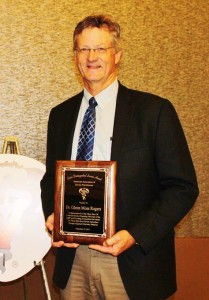 On September 23, 2015, at the American Association of Bovine Practitioners (AABP) Conference held in New Orleans, LA, Dr. Glenn Rogers receives the Zoetis Distinguished Service Award.
The recipient of this award is an individual who, through long and continued service, has promoted the goals of the AABP and whose accomplishments have served as a model for service to bovine agriculture through organized veterinary medicine.
http://www.aabp.org/news/display_news.asp?recnum=320
On September 23, 2015, at the American Association of Bovine Practitioners (AABP) Conference held in New Orleans, LA, Dr. Glenn Rogers receives the Zoetis Distinguished Service Award.
The recipient of this award is an individual who, through long and continued service, has promoted the goals of the AABP and whose accomplishments have served as a model for service to bovine agriculture through organized veterinary medicine.
http://www.aabp.org/news/display_news.asp?recnum=320